
Ahhh! The beautiful colors of the aurora borealis, or the Northern Lights, always brings to mind crisp, clear nights and questions of the seen versus unseen. In 1619, the Italian astronomer, Galileo Galilei, coined the term “aurora borealis” encompassing the the Roman goddess of dawn – “Aurora” with the Greek God for the north wind – “Boreas”.
This solar wind phenomenon is usually seen in higher latitudes (note – not higher elevations) near the Arctic and Antarctic regions – called auroral zones – a band of approximately six degrees (about 660 km) wide in latitude centered on 67 degrees N and S. This oval shaped region (the auroral oval) is displaced by solar winds that move it approximately 15 degrees from the geomagnetic pole (contrast with the geographic pole).
The lights are the result of atmospheric disturbances in our planets magnetosphere (a region of space surrounding earth where charged particles are affected by the earth’s magnetic field) that manifest as various lights in patterns of rays, spirals, and other dynamic flickers of lights that envelop the night sky. The disturbances in the earth’s magnetosphere caused by solar winds result from changes in the speed of the solar winds from coronal mass ejections (a large solar plasma emission that disrupts solar wind flows) and coronal holes (regions of the sun’s corona that emit high level UV light and x-ray radiation that have cooler plasma than its surroundings and are permeated by magnetic fields). These disturbances alter trajectories of charged particles (mainly protons and electrons) in the magnetospheric plasma and precipitate into the upper atmosphere resulting in excitation and ionization of atmospheric particles that emit light of varying complexities and colors. The form of the aurora is also dependent on the acceleration of these precipitating particles.
Many people seem to associate cold weather with the appearance of the aurora; however, the aurora is not affected by temperature. It does not have to be cold or wintertime for the aurora to form, and they do appear in warmer months. Auroras are typically seen more, however, in winter months due to excessive darkness in the Arctic region, and less in warmer, summer months when our planet’s axial tilt results in near constant daylight – and you can’t see it if it is daylight – just like the stars. Therefore, winter is a better time typically to see these beautiful lights almost dancing in the skies above.
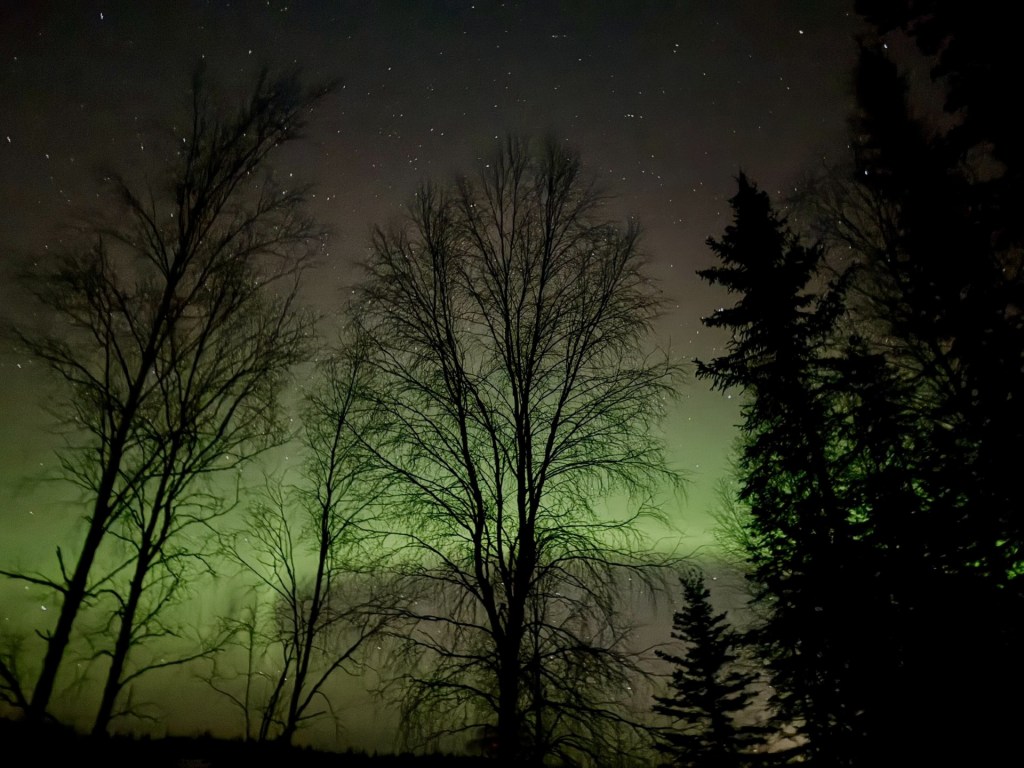
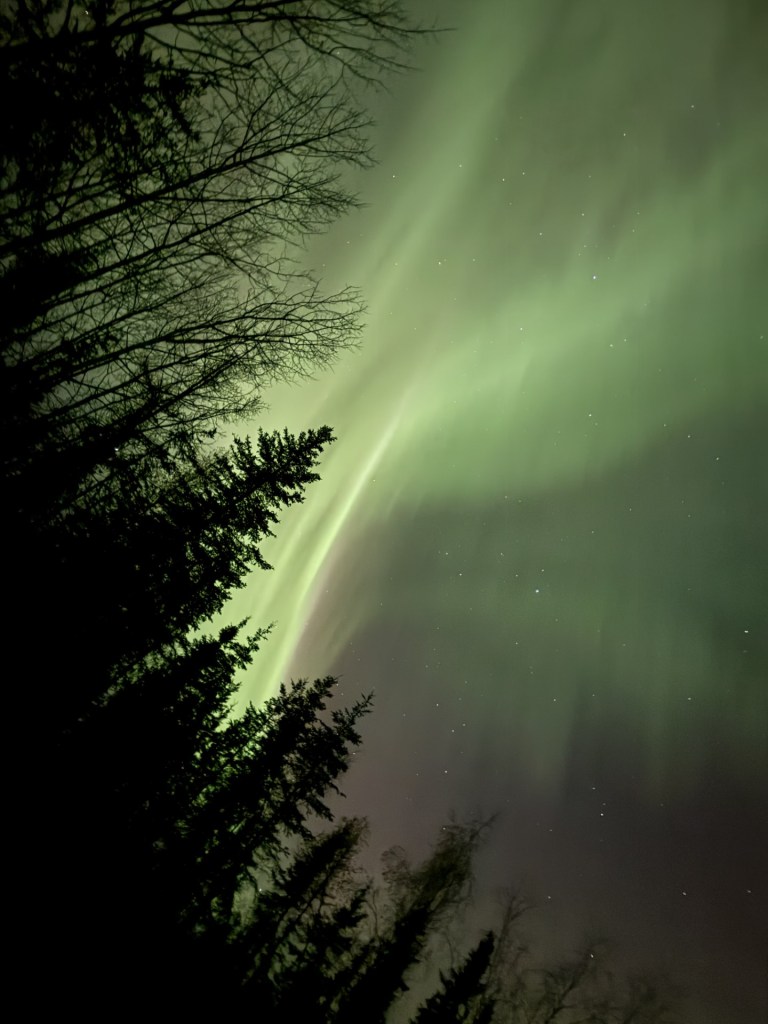
Below – northern lights in November on the Kenai Peninsula. I was quite surprised to see this as the forecast was not good for this sort of visibility that night.
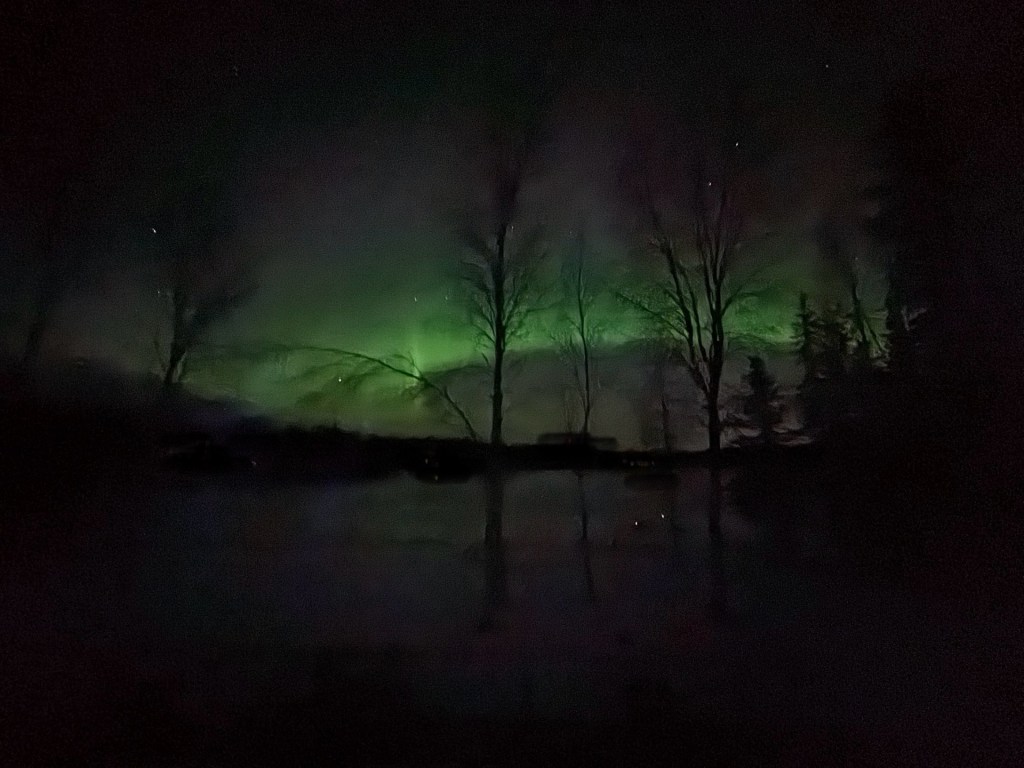
Below – the Northern Lights in September in Yukon Territory Canada – about 400 miles south of the Arctic circle. I was far from any town/light pollution on this very early morning about 0300 hours
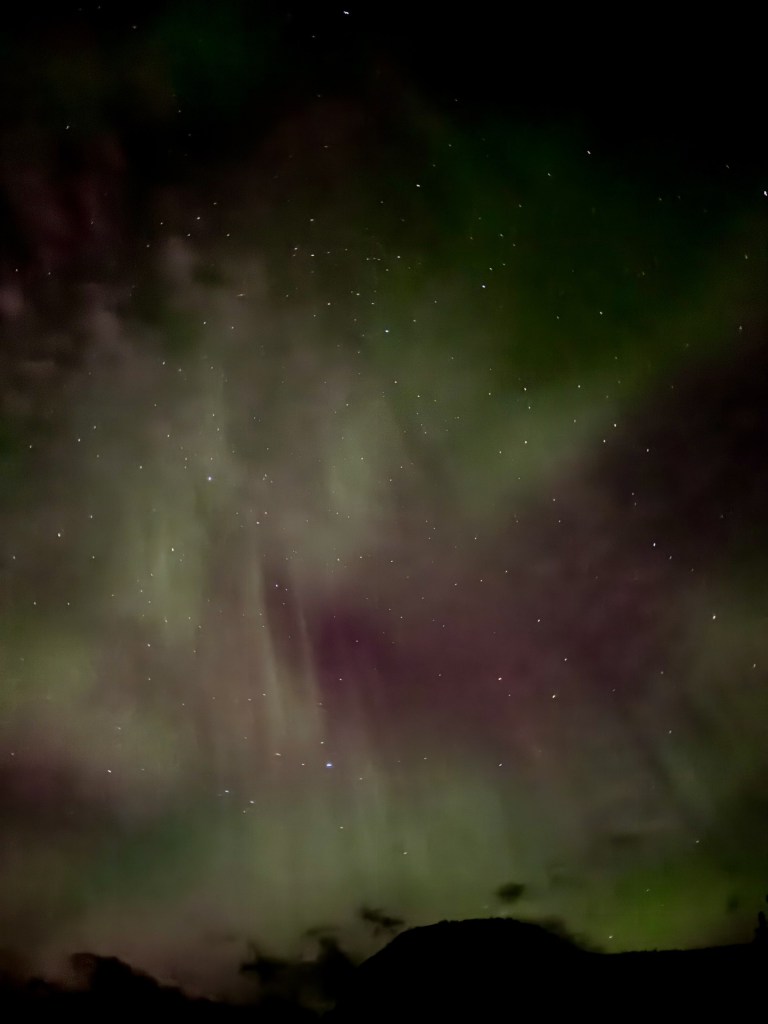
HOW ABOUT THOSE COLORS?
Really beautiful, but in all fairness, it doesn’t always look like this with the naked eye. These photos are not enhanced, but the ISO and lens capabilities of cameras these days pick up colors at night/in dim lightening that we can’t see very well at night with our naked eye since our eyes tend to see shades of black, white and gray at night versus daytime when they use different cells to pick up light (rods cells vs cones cells in our eyes – rods are used mostly at night and have color perception limits that cones don’t – rods detect fainter light in dim settings and can’t perceive colors – they only detect black, white and grey because the light is too dim to be sensed by our color-perceiving cone cells. Hence, why we see less color at night – unless of course the colors are more bright – the farther north you go, the more intense the aurora typically). Nonetheless it’s still pretty cool. And hence, the thoughts mentioned at the beginning of this post about the seen vs unseen when it is there all the while. When you think about it from this perspective, it seems like a really limited perspective to only trust what our human eyes can detect as being present versus not.
More about the colors we see in the Northern Lights
The main factor in what determines the colors we see when we see the aurora is the altitude where the solar particles are colliding with the earth’s atmosphere. Various gases and their associated concentrations prevail at various altitudes and the collision between the atmosphere and these gas particles “excites” the gases resulting in different color variations. We mostly see greens and purples, a result of those specific gases and altitudes where these collisions occur. The majority of solar particles collide in the earth’s atmosphere at about 60-150 miles high where there are high oxygen concentrations that become “excited” and create shades of green in the skies. This, coupled with the human eye’s enhanced ability to detect shades of greens results in these shades predominating when the lights are visible.
Seeing red colors are less frequent, and when it is visible, it is usually secondary to solar particles and oxygen reacting at higher altitudes (generally >150 miles) where there is much less oxygen and it is “excited” at a higher wavelength or frequency than the more dense oxygen concentrations at lower altitudes (making red more visible).
Blues, indigos and purples, my favorite colors in all the color spectrum, are even less frequent and tend to appear when solar activity is increased and the particles are colliding with earth’s atmosphere are <60 miles high (significantly lower altitudes). The reaction with nitrogen, the most plentiful gas in our atmosphere, causes these blue-purple hues closer to our planet’s surface.
On occasion, you might see shades of yellow and pink indicating high solar activity and are a mixture of the red with greens and blues.
I look forward to seeing pinks and yellows someday.


Leave a Reply