
This evening was pretty slow around the village. The day was beautiful with intermittent rain and fog with hazy sunlight coming through the clouds and the sounds of little kids playing across from the clinic in the school yard. I had the windows open most of the day and had just cooked up some lentils for supper when a patient that I had seen earlier in the week came knocking at the clinic door. In his hands were these giant beauties! He said he just “pulled them up from the pot” in a little finger of water locally known as “Skinny Bay” between Akhiok and Kempff Bays. They were not seasoned with anything, and the meat was so delicate and sweet and like no other king crab legs I ever had (which have only been from a restaurant or store bought). It was truly a delicacy and such a nice gesture from a practical stranger. So, with that, I had to say for the night, goodbye lentils, and hello king crab legs! I am going to try and make this last through Monday, my last day in the village; but something tells me I might be taking a nibble in my long johns tonight in the refrigerator light. I could get used to this. I should have placed something next to the claws before I peeled them to show their massive size. Next time.


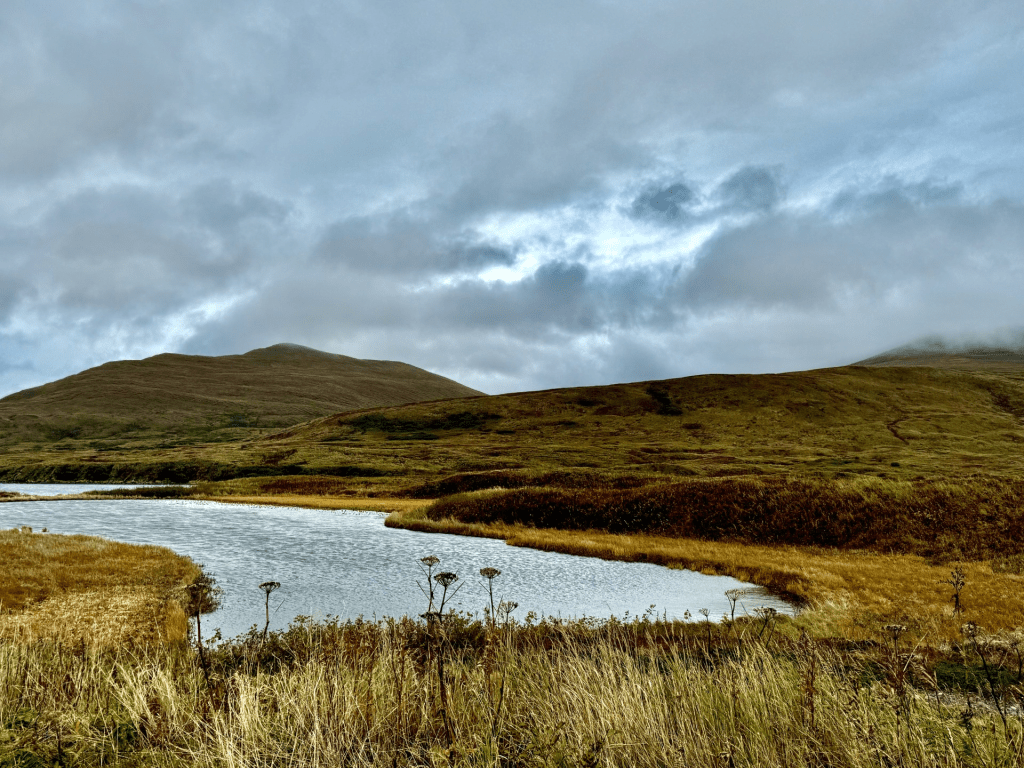
Pictured above: Skinny Bay from the road near the airport yesterday
Wildlife (Sea Life) Corner
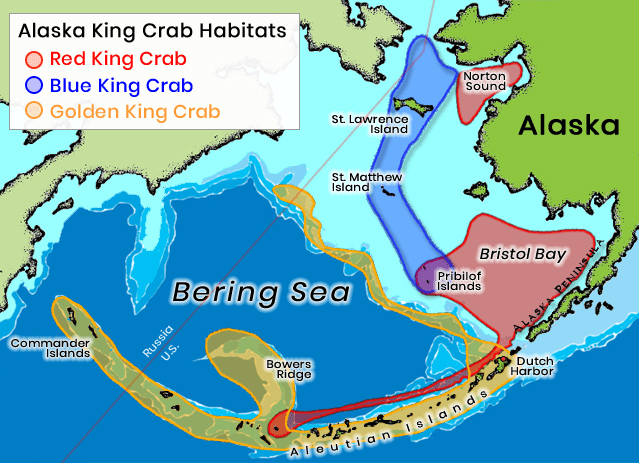
Alaskan King crabs are spiney creatures found in the Gulf of Alaska, the Bering Sea, the Aleutian Islands, and as far south as British Columbia, Canada. Bristol Bay, the Pribilof Islands, Norton Sound, and the Western Aleutian Islands host the four king crab stocks.
These giant crabs measure up to FIVE FEET and weigh over 20 pounds!!! They are brownish-green-red crabs with spiny shells, 6 legs, 2 claws and are truly well suited for their name! They remind me of giant aquatic spiders or the Robot Spy in my favorite cartoon, after all things Peanuts, Jonny Quest!
There are 4 types of Alaskan King crabs – red, blue, golden and scarlet. Red kings (Paralithodes camtschaticus) are in Bristol Bay, and this is the common type in the US, Japan and Europe that are sought after for human consumption. Each year in Alaska, Bristol Bay hosts about 100 King crab fishing boats over a 2–3 month period for harvesting. When alive, these crabs have a deep burgundy-scarlet color, turning to red once cooked. Blue King (Lithodes platypus) crab are known for sweet meat and giant claws and are found near Dutch Harbor, AK and Pribilof Islands off of the coast of Alaska. They are beautiful shades of indigo and blue when alive, turning bright orange-red once cooked. Golden Kings (Lithodes aequispinus) are found near the Aleutian chain islands in and are the smallest in size of all the King crab species. The have the least amount of meat and are typically more mild tasting than the other species of King crabs. Last is the Scarlet King crab (Lithodes couesi), found in the Bering Sea, and not marketed commercially due to their smaller size and unsustainable populations if commercial harvesting were allowed.
They live mostly in intertidal waters up to 200 feet deep. Second only to sockeye salmon, King crabs are the second most valuable commercial species in Alaska.
The King crab’s shell (called a carapace) is a fixed, external skeleton (exoskeleton) which cannot expand to accommodate the crab’s growth and must be molted or shed regularly in order for it to grow larger. The crab will begin constructing a new, larger exoskeleton inside the old one before molting, then the outer shell splits open when the new shell becomes too large to be contained, and the new exoskeleton begins to harden. If you catch one of these crabs just as it has shed its exoskeleton, and before the new one hardens, it is termed a “soft shelled crab” and is hands down MY VERY FAVORITE seafood dish! The crabs are at increased risk for predation with less protection during this time between hard shell molting and the new shell hardening.
Fun fact – the right pincer claw is usually larger on adults. The right claw is larger, and more powerful and used for smashing prey, while the more delicate left claw is used to handle food items.
Alaskan king crabs reproduce via internal fertilization where the females brood fertilized eggs beneath their bellies for up to 1 year. The females prefer colder waters as they focus on feeding themselves and caring for their eggs; therefore, in summer months, they are found in waters much deeper than other times of year – waters up to 600 feet deep, moving to shallower waters in late winter where eggs hatch in spring, and the sexually mature animals will grow larger, molt and mate once more. Just think – a world where you get to mate more as you grow larger. Ha!
Regional note – The blue crab, another species of crab found in the southeastern US/Gulf of Mexico regions, also carry eggs and are known as “crab butter” amongst some folks such as my mom and dear ole Grams. She and her side of the family loved to spread the “crab butter” (eggs) on saltines with a cold beer. I have many good memories of being at the kitchen table with newspaper spread out as a tablecloth and a pile of boiled crabs on top in the center from which we all ate, eating messily as we picked crabs and ate “crab butter” on saltines. These were also the days when as kids we could sip the foam off the top of the adults’ beers. I can still see the kitchen we had back then with those crabs laid out on the table next to the freezer where my dad had a tap coming from a cold keg through the freezer wall. Many fond crab eating and beer foam tasting memories around that table.
Outside of the breeding season, King crabs are solitary animals; however, in the presence of other powerful predator species, they will band together forming a pod to appear larger and more dangerous. These pods may reach heights of several feet with stacks of hundreds of crabs!
Not my pic: taken from the internet of a crab pod as described above. Kinda creepy. I think I’d go the other way if I saw this.

King crabs have many predators including various fish (Pacific cod, sculpins, halibut, yellowfin sole), octopuses, cannibalistic king crabs, sea otters, and humans. Numerous species of nemertean worms (ribbon or proboscis worms) have been discovered to consume king crab embryos. You would think that no species would be able to prey easily on the adult crabs with their sharp protective spines – just peeling one of these is brutal to the fingertips.
Alaskan king crab adults migrate annually from shallow waters close to shore to deeper waters before returning again closer to shore later in the year. They arrive in shallow waters in late winter, and the females’ eggs hatch in the spring. Before the start of their offshore feeding journey to deeper waters, they mate and molt; while off the mating-molting grounds, adult crabs often separate by sex. To avoid predation, juveniles (<2 years old), live in shallow complex habitats such as shell hash, cobble, algae, and among bryozoans (microscopic aquatic invertebrates that live in colonies). The older juveniles form travelling pods and keep busy “mounding up” (creating protective mud mounds) during the day and feeding at night. Mature crabs move into deeper water (usually <600 feet) along the continental shelf to feed. Mature females return to shallow waters to hatch their eggs. During their lifespan, the crabs settle between 200 and 600 feet deep.
In the Kodiak region, adult male King crabs have been observed travelling as fast as 1 mile per day and up to 100 miles round-trip annually!


 jensnorthernexposure.com
Leave a reply to Ned Derickson Cancel reply